
Runnels County Parole Versus Probation
Parole and probation both allow a person to live outside a secure facility under rules, but they begin in different ways. The Texas Board of Pardons and Paroles votes on parole and mandatory supervision for a person serving a TDCJ sentence. TDCJ Review and Release Processing then checks the release plan, program needs, and special conditions. The TDCJ Parole Division supervises the person after the prison release occurs. A vote marked favorable is one step in that chain. It does not establish the day or time the person left prison.
Probation, called community supervision in Texas records, is ordered by a court. Runnels County probation is administered through Concho Valley Community Supervision and Corrections Department, not by the parole board. The judgment and probation order define the term and conditions. The local CSCD may confirm information it is allowed to disclose, but it cannot certify the physical release time from Runnels County Jail.
| Question | Parole or mandatory supervision | Probation |
|---|---|---|
| Who starts it? | Texas parole process after a TDCJ sentence | The trial court through its judgment |
| Who supervises? | TDCJ Parole Division | Concho Valley CSCD Region II |
| Best proof | Release certificate and agency confirmation | Judgment, probation order, and CSCD confirmation |
| Does it prove jail release time? | No | No |
The legal status matters. A person can be released from prison onto parole yet remain under the same sentence. Final discharge comes later, when the sentence and its supervision end.
- Parole
- Conditional release from prison to serve the rest of a sentence under supervision.
- Probation
- A court-ordered term of community supervision, sometimes imposed instead of confinement.
- Mandatory supervision
- A statutory form of supervised prison release controlled by eligibility rules and, in many cases, Board review.
- Discharge
- Completion of the sentence and applicable supervision.
Check Runnels County Release Supervision
Begin with the sentence source, not a name-only web search. A Runnels County jail departure may be bond, time served, transfer, probation, or another event. If the person entered TDCJ, the public TDCJ inmate search can help only while the person remains incarcerated. It does not keep former prisoners in a released-status archive. State IVSS, the release certificate, and the Parole Division are better sources after release. For probation, use the court file and Concho Valley CSCD.
- Identify the custody layer. Ask whether the person left Runnels County Jail for the community or was transferred to TDCJ. A county release sheet should state the event and destination.
- Read the court record. A probation judgment comes from the court. County-level misdemeanor records route through the County Clerk; felony records route through the District Clerk.
- Check a current TDCJ case carefully. The TDCJ detail may show parole-review status while incarceration continues. Disappearance from that search is not proof of release.
- Use the correct supervision office. Contact TDCJ Parole Division for parole or mandatory supervision. Contact Concho Valley CSCD Region II for probation.
- Ask for event proof. A TDCJ release certificate confirms prison departure and conditions. A judgment and CSCD record establish probation. Neither should be replaced by a roster no-result.
A narrow records request is useful when public systems disagree. Ask TDCJ for the actual release date, release type, release certificate, and incarceration history. For a county event, ask the Sheriff for the booking and release sheet. The broader Runnels County released-inmate search path explains how to separate a community release from transfer.
Runnels County Probation Office
Runnels County has a local probation route in Ballinger. Concho Valley CSCD Region II handles community supervision arising from local court cases. It must not be described as a TDCJ parole office. Call with the person's full name and case number if known, and ask only for information the department may disclose. Published office hours were not captured in the official sweep, so confirm availability before visiting.
Concho Valley CSCD Region IIRunnels County Courthouse
608 Strong Avenue
Ballinger, Texas 76821
325-365-3452
The CSCD main office is at 3036 North Bryant Boulevard in San Angelo and can be reached at 325-659-6544. The Region II office page is the direct local source. A CSCD response concerns probation supervision, not a state-prison release decision or the time jail staff processed a county release.
Runnels Release Violations and Warrants
Conditions vary by order and sentence. They can involve reporting, travel limits, approved residence, programs, or other duties stated in the release certificate or probation order. A violation allegation can lead to a warrant and a later revocation process. Hearing Operations handles alleged parole violations after release. Those proceedings differ from the Board's initial file review of an incarcerated person.
An absconder is someone alleged to have stopped reporting or otherwise left supervision without permission. That label does not mean the sentence ended. Nor does it always mean the person is in a jail. A warrant may remain active while the person is outside a secure facility. Texas offers a Sex Offender Absconder search for the population it covers, but the research found no Runnels-specific public list for all probation or parole absconders. The supervising agency and warrant authority are the sound sources.
State IVSS can preserve notices tied to TDCJ custody, parole, or mandatory supervision. The separate county IVSS system may cover county and court events. Neither alert system replaces the order, warrant, or final revocation record. Save the event notice and then confirm it with the agency that issued the underlying action.
Note: A new county booking on a supervision warrant is a current custody event after release, not proof that the earlier release never occurred.
Runnels County Supervision Discharge
Supervision ends through an agency or court action, not merely because a person stops appearing in a search. TDCJ defines discharge as completion of the sentence and release from incarceration, parole, mandatory supervision, or community supervision. That is more final than release from prison onto parole. For probation, the court and CSCD records show whether the term was completed, modified, revoked, or ended through another order.
For a prior TDCJ case, request incarceration history and the final release or discharge record through the TDCJ Public Information route. Texas Government Code Chapter 552 governs access, lawful redactions, and charges. The current-inmate search will usually cease to show a former prisoner, so its no-result cannot substitute for a discharge record.
A complete verification keeps three dates separate: the date secure custody ended, the date supervision began, and the date the sentence was discharged. They may be far apart. Ask for the precise record that answers the precise question.
Note: Parole means release from prison under conditions; discharge means the sentence and its supervision have reached their legal end.
Runnels Parole Review Has No Calendar
Ordinary Texas parole consideration is a file review, not a formal public hearing for each incarcerated person. TDCJ identifies a case before eligibility, an Institutional Parole Officer interviews the inmate, and a three-member panel reviews the file. Two votes decide the result. The Board's public quarterly meetings are not individual parole hearings and should not be used as a release calendar.
Decision codes also need context. FI-1 can call for release when eligible, while other favorable codes may set a future date or require a program. NR sets a later review; SA means serve all; DMS denies mandatory supervision with another review date. A favorable result can still be withdrawn. The official parole review workflow shows the review stages.
The source page above provides the official context for this Runnels County parole review image.
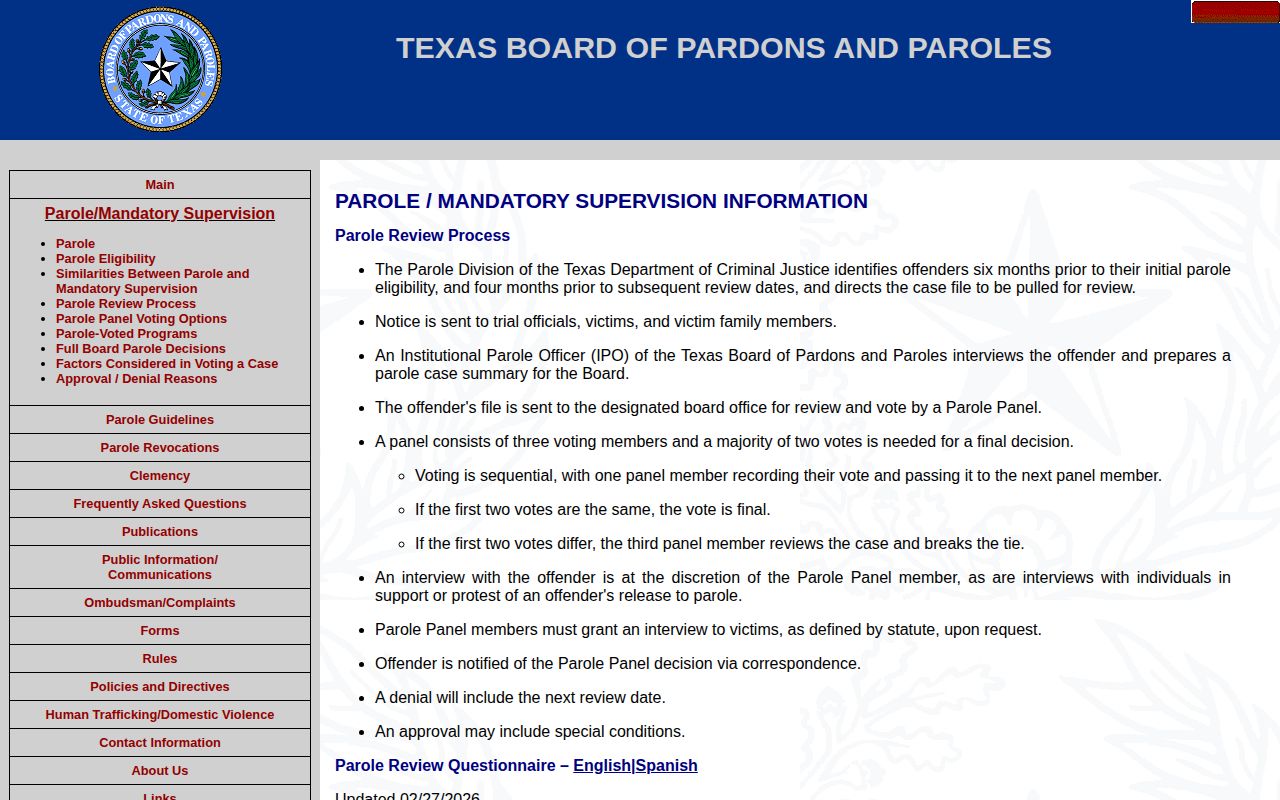
The image reinforces why a review or vote must be followed by release processing and an agency record before departure is treated as confirmed.
Runnels Parole Release Processing
After an approval, TDCJ Review and Release Processing verifies the plan, required programs, and conditions and issues the release certificate. Its published office is 8610 Shoal Creek Boulevard, Austin, Texas 78757, with 512-406-5449 as the office number. TDCJ materials also list 512-406-5202 for release status after approval.
For an incarcerated person's current review status, TDCJ lists 844-512-0461, Monday through Friday from 8 a.m. to 5 p.m. Central. Have the full name, TDCJ number, and date of birth. The public inmate detail can show review information while the person remains in custody. It remains a current-only system, not a historical release record.
Once release occurs, the certificate identifies the legal route and conditions. State IVSS may give a timely event notice, and Parole Division can address supervision. If the question is final sentence completion, request the discharge record instead of treating release from prison as the end of the case.
The parole vote-options record can also prevent a false date claim. A future-date or program-conditioned vote is not the same as FI-1 release when eligible. Consecutive-sentence codes can keep custody in place even after a favorable decision on one sentence. Read the full code and current case detail, then confirm that Release Processing completed the plan. If the person no longer appears in the public TDCJ search, request prior incarceration history rather than claiming the absent result shows discharge.
Runnels County probation needs the same care. A court order may start probation, extend it, amend a condition, or revoke it. The filed order and permitted CSCD confirmation control. A jail roster disappearance can support none of those conclusions by itself. Keep the booking event, court action, release event, and supervision event as separate entries in any timeline.