
Runnels Projected Versus Actual Release
A projected release date is a calculation, not a completed event. TDCJ defines it as the date Classification and Records projects prison release if the inmate is not paroled earlier. Its value depends on the offense date, mandatory-supervision eligibility, sentence data, and time credits. A scheduled release is closer to implementation because release processing has set a plan. Even that date may change before departure.
An actual release date records when custody ended at a facility. The destination matters just as much. Release from Runnels County Jail to TDCJ, USMS, ICE, or another county is a transfer and not freedom from secure custody. Release from prison onto parole ends incarceration but does not discharge the sentence. A final discharge date marks completion of incarceration and any applicable supervision.
Pretrial cases work differently. A person awaiting court action often has no projected date. A posted bond, dismissal, court order, detainer, or later sentence may control when release becomes possible, while jail staff must still complete processing. Do not create a date by subtracting days from a bond amount or by reading a blank projected field in the county roster schema.
- Parole eligibility
- The date legal review may become available, not a promise of release.
- Projected release
- A changeable calculation based on Texas rules and the person's record.
- Scheduled release
- A date and release type in active processing, still subject to change.
- Maximum sentence date
- The end point derived from the sentence, not always the expected prison departure.
- Actual release
- The recorded physical departure event and route.
Find a Runnels Projected Release Date
Start by asking where the person is held and whether a sentence exists. The official Runnels roster is current-custody oriented. Its database can carry a projected field, but that field was null in the observed current sample and does not create a public release-date archive. The jail and court supply the county calculation. TDCJ supplies the state-prison calculation.
- Check present county custody. Search the official Runnels roster. If listed, note the booking identifier and charges, but do not treat bond or a roster field as a release promise.
- Separate pretrial from sentenced status. Consult the County Clerk for county-level misdemeanor matters or the District Clerk for felony matters. Look for bond, judgment, sentence, commitment, or later orders.
- Ask the jail for a county calculation. For a county sentence, call 325-365-2110 and request the sentence computation tied to that booking. The Sheriff has not published a local good-time table.
- Search TDCJ only for current inmates. Enter the exact last name plus a first initial, a seven-digit TDCJ number, or SID. Open the detail and compare all date fields.
- Request history after release. A former prisoner normally disappears from the current TDCJ search. Ask TDCJ for incarceration history and the actual release or discharge record.
The TDCJ current-inmate search uses last name, first name, TDCJ number, SID, gender, and race. Its results can show projected release, unit, and age. Details may show maximum sentence, parole eligibility, scheduled release date and type, review data, and offense history. TDCJ says working-day updates can be at least 24 hours old.
A no-result is ambiguous. It may reflect release, a spelling mismatch, an incorrect number, intake lag, or another system. The Runnels County released-inmate record path combines jail, court, state, and federal channels when the current search cannot answer the question.
Runnels Release Date Credit Rules
Texas Government Code Chapter 498 governs TDCJ good-conduct classifications, accrual, forfeiture, and restoration. Good time can affect eligibility calculations, but it does not shorten the judicial sentence itself. Offense date is critical because amendments and legacy rules apply. Mandatory-supervision rules and exclusions appear in sections 508.147 and 508.149, while section 508.145 controls parole eligibility.
There is no blanket Texas rule requiring every prisoner to serve 85 percent. For many offenses listed through Article 42A.054 or involving a deadly-weapon finding, section 508.145(d) generally measures eligibility using actual calendar time equal to one-half of the sentence or 30 years, whichever is less, with minimum and offense-specific terms. Good time does not supply that one-half calculation. For many other cases, flat time plus good time can reach eligibility at one-fourth of the sentence or 15 years, whichever is less under section 508.145(f). Eligibility still does not guarantee release.
For eligible offenses committed before September 1, 1996, flat time plus good time reaching the sentence can set the mandatory-supervision projection. In many later eligible cases, the same arithmetic is subject to Board approval. If mandatory supervision is denied, the projected date can reset to maximum expiration. A later approval can move it earlier.
Note: The controlling offense date, sentence, eligibility category, and current credit record must be checked before any Texas release calculation is trusted.
Why Runnels Release Dates Change
A date may move because the facts or legal status feeding the calculation have changed. TDCJ's projected date is not a static promise. A county release estimate can also fail when another charge, hold, or court order appears. Ask which factor changed instead of assuming the first date was an official guarantee.
| Factor | Possible effect | Best confirmation |
|---|---|---|
| Good-time forfeiture or restoration | Moves an eligibility or projection calculation | TDCJ Classification and Records |
| Mandatory-supervision denial or approval | Can reset projection to maximum or move it earlier | Board decision and TDCJ detail |
| Parole vote | May start release planning or set a later review | Board status and release processing |
| Program requirement | Can delay a favorable release route until completion | Vote code and TDCJ record |
| Detainer or receiving agency | Changes community release into transfer | Hold and destination records |
| Court or sentence correction | Changes credit, term, or lawful custody basis | Filed court order |
| New or consecutive case | Can extend custody past one case's date | Court and agency records |
For parole, a favorable vote alone does not show that a person has left prison. Review and Release Processing verifies plans, conditions, and program requirements and issues the release certificate. New information can cause withdrawal. The actual record is the sound endpoint.
Confirm a Runnels Release Date
Use a prospective date to plan a later verification, not to state that release has occurred. For Runnels County Jail, call 325-365-2110 and ask for the actual processed date and time, release type, and destination. If a written record is needed, request the booking and release sheet. The county website publishes no dedicated Sheriff request form, fixed local fee, or promised turnaround, so confirm delivery method and request a cost estimate.
For TDCJ history, the informal inmate-information email can provide incarceration history and projected information without charge when given a TDCJ number or strong identifiers, but it does not provide photographs. Use the formal TDCJ Public Information form for an actual release certificate, date, type, discharge record, or other formal material.
Texas IVSS notifications can preserve a release event if registration occurs while the person is visible. County IVSS and the separate state-prison IVSS cover different layers. The Runnels County IVSS notification steps explain the migration from VINELink and the released-person disappearance warning.
Note: Notification delivery time may differ from the underlying event time, so use the jail or TDCJ record for the actual timestamp.
Runnels County Jail Good Time
County jail good time follows a separate rule from TDCJ prison credits. Texas Code of Criminal Procedure Article 42.032 authorizes a sheriff to grant commutation for good conduct, industry, and obedience. Special work-release classification provisions also exist. Those rules do not justify applying a TDCJ formula to a Runnels County sentence.
The Runnels County Sheriff has not published a local credit table or online calculator. Request the sentence computation for the named booking. It should begin with the judgment, jail credit, and the Sheriff's actual classification record. If a court order and jail computation appear to conflict, ask the clerk and jail to identify the controlling filed order and credited days.
Pretrial time may later count toward a sentence, but that does not give a detainee a fixed release date while bond, case outcome, detainers, and court action remain unresolved. Keep an estimate labeled as an estimate until the custodian confirms it.
Texas Release Dates Can Reset
Runnels County cases that move into TDCJ can show an especially confusing pattern. A projected date may move to maximum expiration after denial of mandatory supervision, then move earlier after later approval. That does not necessarily mean sentence records were entered incorrectly. The date reflects the current statutory and Board posture.
The TDCJ definitions page is the official source for projected release and discharge terminology shown below.
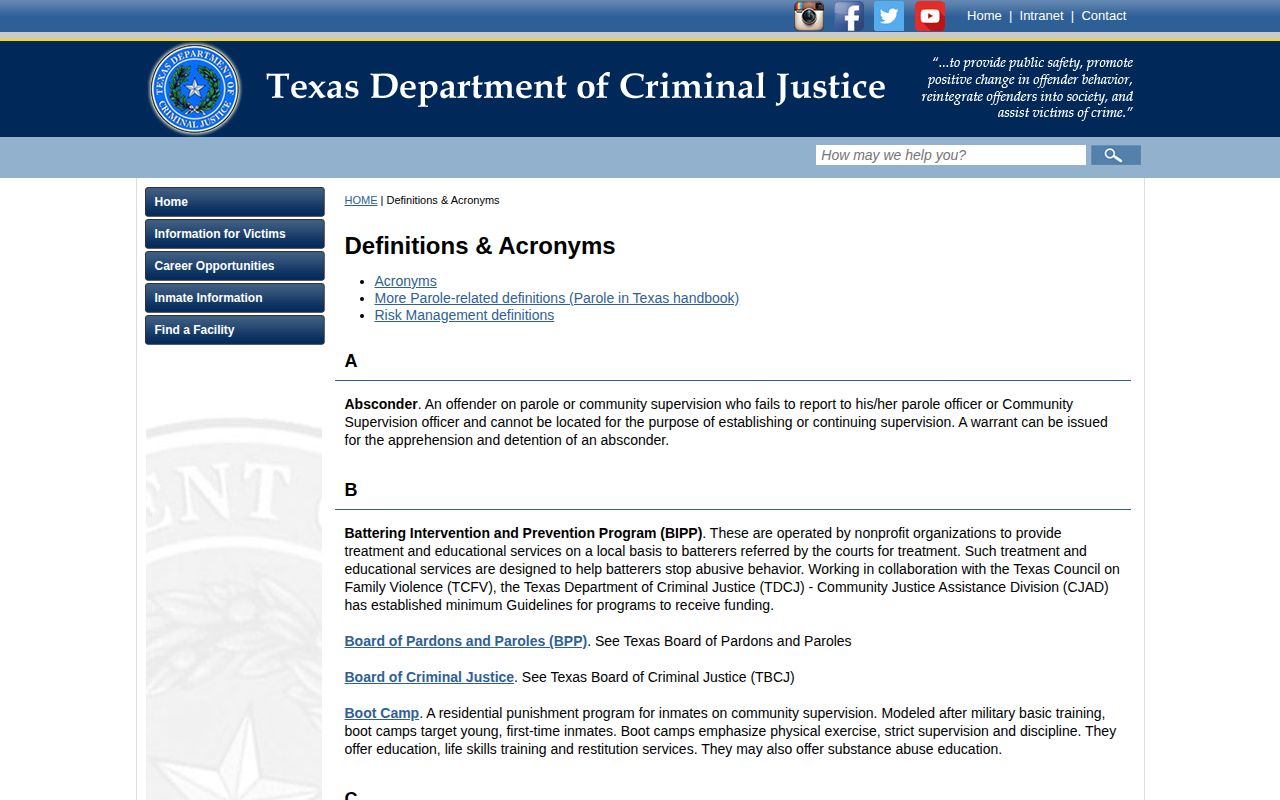
The definitions help separate a forward-looking projection from final discharge, which may follow prison release after a period of parole or mandatory supervision.
When a date changes, preserve the earlier result and observation date. Then ask TDCJ which input changed. A comparison of maximum sentence, eligibility, projection, scheduled release, and Board status is more useful than reading any one field in isolation.
Suppose a current detail shows an eligibility date and a later projected date. The first means review may become legally available; the second is the current calculation if no earlier parole occurs. If a scheduled block later appears, it signals active processing but remains subject to holds and requirements. Once the person leaves, the release certificate or final record supplies the actual date and release type. None of the earlier fields should be relabeled as historical proof.
For a Runnels County sentence, the parallel evidence comes from the local judgment, jail credit, Sheriff's computation, and final release sheet. The statewide formulas cannot fill a missing local computation. A transfer destination must also be preserved because the day the county booking closes may be the day another agency's custody begins.
This layered approach avoids two common errors: treating eligibility as a promise and treating disappearance as release. Both shortcuts ignore the records that show whether a planned date became a completed community release, a supervised prison release, a transfer, or final discharge.
If the date is needed for travel or pickup planning, call the holding facility before leaving. Runnels County has not published a release door, waiting area, processing hours, or weekend rule. A projected date cannot supply those missing logistics, and staff processing or another agency hold may alter the practical timing.